
Making Full Use of Your Disabled Facilities Grant Funding

Disabled Facilities Grant (DFG) funding has more than tripled in ten years, but turning that money into finished home adaptations is taking longer. Here's how much councils have, how long residents are waiting, and how NPA can help.
How much Disabled Facilities Grant funding do councils have?
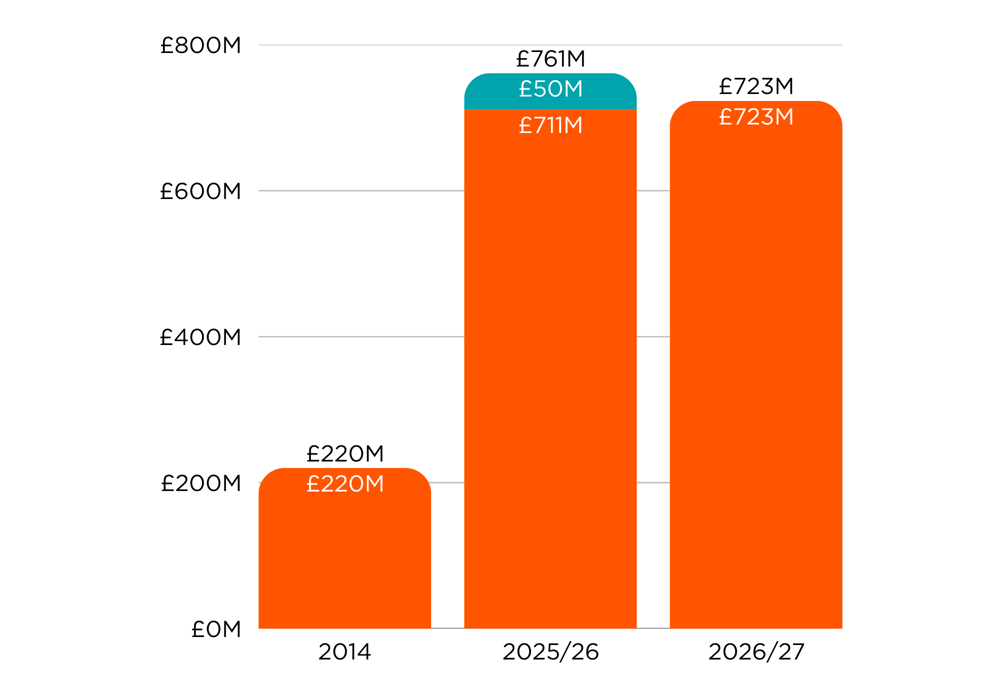
The government has confirmed £723 million for the Disabled Facilities Grant in England for 2026/27. In 2025/26 the total was £761 million, including a one-off £50 million added part way through the year. Ten years ago, in 2014, it was £220 million (GOV.UK; Foundations).
Each council's share depends on local need, so allocations vary widely. Manchester, for example, has £10.5 million for 2026/27, while Newcastle received £3.38 million (GOV.UK).
The money pays for adaptations such as stairlifts, ramps, level access showers and extensions, up to a maximum of £30,000 per grant in England. Councils have to report any funding they don't spend.
How long are Disabled Facilities Grant waiting times?
Most councils meet the statutory deadlines. Applications must be approved within six months of a valid application being received, and works completed within 12 months of approval. However, performance against the government's recommended timescales is much more mixed.
The government's 2022 guidance sets tighter targets, and this is where councils fall behind. The latest national figures, for 2023/24, show the average DFG took 247 working days from identifying the works to finishing them, up from 223 the year before.
The guidance recommends 155 working days for those stages in a non-urgent, complex case, and only around one in ten councils meets that target.
Two stages account for most of the gap:
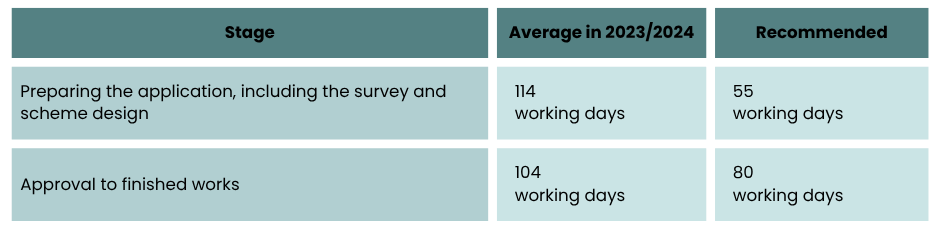
(Source: Foundations DFG Performance Data)
Both stages depend on having enough surveyors and contractors. Recruiting permanent surveyors is slow and not always possible, local contractor lists can be thin, and demand for larger, more complex adaptations has been rising.
Every case on a waiting list is someone living in a home that no longer works for them, such as an older person unable to safely access their bathroom or leave their property independently. Long waits also increase pressure on occupational therapists, adult social care teams and carers.
How NPA can help councils use their Disabled Facilities Grant funding
NPA frameworks give councils access to contractors and surveyors who have already been through a robust procurement and evaluation process, including assessments of quality, price, capability and relevant accreditations. This provides a compliant route to bring in additional capacity through either direct award or mini-competition, depending on the council’s requirements.
- RM3 gives access to contractors who can deliver a wide range of refurbishment and adaptation works, including level access showers, ramps, stairlifts, through-floor lifts, door widening and other accessibility adaptations.
- MDC1 gives access to building surveyors and other property consultancy specialists who can support with surveys, feasibility work, design, specifications, project management and related professional services needed to progress adaptation schemes.
Both frameworks can be accessed through direct award or further competition, helping councils bring in additional capacity more quickly than running a standalone procurement exercise.
These match the two stages where cases wait longest. Councils can use them alongside their own teams and existing contractors, to clear a backlog, cover a vacancy or handle a busy period, and get more of their DFG funding turned into finished work.
In addition to helping councils increase capacity, projects delivered through NPA frameworks can also support wider social value outcomes, such as local employment, apprenticeships, skills development and community benefits.
Disabled Facilities Grant FAQs
Need more capacity to use your Disabled Facilities Grant funding?
If your council has Disabled Facilities Grant funding to spend but not enough surveyors or contractors to get the work done, we can help. Talk to us about how RM3 and MDC1 could support your adaptations service this year.