
Building Safety Act client duties for schools, hospitals and council buildings

If your organisation commissions building work, the Building Safety Act now places legal responsibilities on you as the client.
Since October 2023, anyone commissioning building work in England has legal duties for how the work is planned, who carries it out and whether the finished building complies. This guide explains those Building Safety Act client duties in plain English, and what to do before your next project.
In this guide:
- whether the Building Safety Act applies to public buildings
- your client duties under the duty holder regime
- fire risk assessment duties under section 156
- which public buildings count as higher-risk
- how to check contractor competence, and where a framework helps
Does the Building Safety Act apply to public buildings?
Most people link the Building Safety Act 2022 with high-rise flats, which is understandable as the Act was a response to the Grenfell Tower fire. But the Building Safety Act also applies to public buildings. Some of its biggest changes cover almost every building project in England, including schools, health centres, libraries, fire stations and council offices.
If your organisation commissions building work, the law now treats you as the "client", with legal duties of your own. You can't hand those duties to your contractor.
Building Safety Act client duties under the duty holder regime
Since 1 October 2023, every building project in England that needs Building Regulations approval falls under the Building Safety Act duty holder regime. Very minor work that doesn't need approval is exempt, but most refurbishments, extensions, new builds and many building services upgrades are covered.
The duty holders are:
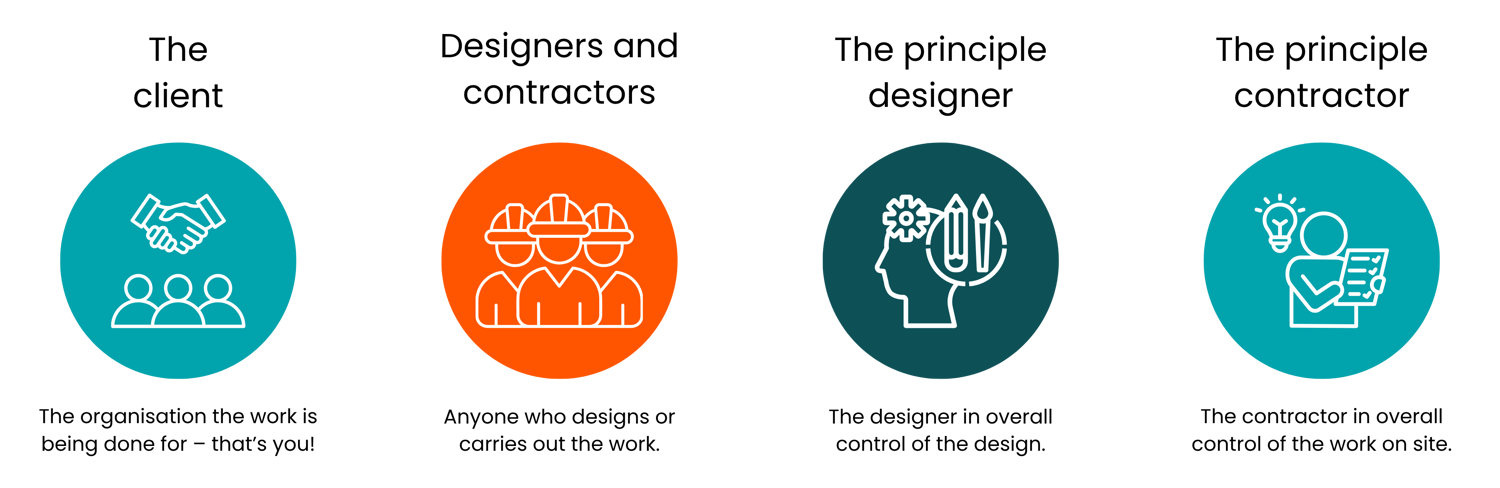
As a client, your Building Safety Act duties are to:
1. Plan, manage and monitor the project properly
That includes giving the team enough time and money to do the job right. An unrealistic programme or a squeezed budget can put you in breach.
2. Check competence before anyone starts work
You need to take reasonable steps to be satisfied that designers and contractors have the skills, knowledge, experience and behaviours for their role. Keep a record of how you checked.
3. Appoint a principal designer and principal contractor in writing when more than one designer or contractor is involved, which is most projects.
4. Share information
Designers and contractors need what you know about the building to do their jobs safely.
The principal designer and principal contractor roles share names with the roles under the Construction (Design and Management) Regulations 2015 (CDM). They are separate legal roles, though the same firm can hold both.
Fire risk assessment duties under section 156 of the Building Safety Act
Section 156 of the Building Safety Act changed the Fire Safety Order, tightening the rules for whoever is the "responsible person" for fire safety in a non-domestic building. For most public buildings, that's the organisation in control of the premises: a council, trust, academy or governing body.
Since 1 October 2023, responsible persons must:
- Record the whole fire risk assessment in writing, with all its findings. The old exemption for organisations with fewer than five employees has gone.
- Record the fire safety arrangements, meaning how fire safety is planned, organised, controlled, monitored and reviewed.
- Record who carried out the assessment, if you used an outside assessor, including their name and organisation.
- Work with other responsible persons in shared buildings, such as a community hub with a library, GP surgery and café, so fire safety works for the whole building.
- Pass on fire safety information to whoever takes over responsibility for the building.
This matters for building work too. Refurbishments often change escape routes, compartments and fire doors. Your fire risk assessment needs to be reviewed when the work is done, and your contractor should hand over the information you need to do that.
What is a higher-risk building under the Building Safety Act?
A smaller group of buildings falls under a much tougher regime run by the Building Safety Regulator. For design and construction, a "higher-risk building" is one that is at least 18 metres tall or has at least seven storeys, and is:
- a hospital
- a care home, or
- a building with at least two homes in it, such as a residential block
So a new seven-storey hospital wing counts. A three-storey secondary school doesn't, and neither does a typical council office.
For higher-risk building work, the Regulator must approve the design before work can start on site. The law gives it 12 weeks to decide on a new building and eight weeks for work to an existing one, unless both sides agree longer. The building can't be occupied until the Regulator signs off the finished work, and a digital record of safety information, known as the "golden thread", must be kept.
If you're planning a tall hospital building or a block of homes, factor these approval stages into your programme from the start. The higher-risk building regime applies differently during design, construction and occupation, so organisations delivering hospital or care home projects should ensure they understand which requirements apply at each stage.
How to check contractor competence under the Building Safety Act
Demonstrating contractor competence is one of the biggest practical challenges facing public sector clients. Many organisations don't have the time or technical expertise to conduct detailed assessments for every project. One way many public sector organisations manage this is by using a compliant framework that has already assessed suppliers as part of the procurement process.
This is where a public sector construction framework can take a lot of the work off your plate. Contractors on our new Public Buildings Construction and Infrastructure framework (PB4) have already been through a full tender and evaluation before they could be appointed. One way many public sector organisations manage this is by using a compliant framework that has already assessed suppliers as part of the procurement process.
PB4 covers:
- New build and refurbishment of public buildings, from smaller projects up to schemes worth more than £25m
- Civil infrastructure, such as roads and drainage
- Hard facilities management, including mechanical and electrical systems, fire safety, lifts and building fabric
It's open to councils, schools and academies, universities, NHS bodies, emergency services, housing associations and other publicly funded organisations. You can appoint through direct award or a mini-competition.
Building Safety Act FAQs
Find contractors through the PB4 public buildings framework
Planning a new build, refurbishment or maintenance programme? Our team can talk you through PB4, how to call off from it and what to ask contractors about competence. Get in touch with the NPA team or find out more about PB4.